FOIA Advisor

Court opinions issued Aug. 31, 2016

Court Opinions (2015-2024)Allan BlutsteinComment

Dongkuk Int'l v. U.S. Dep't of Justice (D.D.C.) -- concluding that a request for assistance made by a foreign government -- in this instance, the Republic of Korea --  under a Mutual Legal Assistance Treaty is exempt from disclosure under Exemption 3.

Intellectual Property Watch v. U.S. Trade Representative (S.D.N.Y.) -- denying in substantial part plaintiff's motion for reconsideration of court's decision that certain draft text, memoranda, and communications relating to the Trans Pacific Partnership ("TPP") were properly withheld under Exemption 1; denying both parties' motions for summary judgment on USTR's withholdings pursuant to Exemption 3 in conjunction with 19 U.S.C. § 2155(g)(2),(g)(3).

Summaries of all opinions issued since April 2015 available here.  

FOIA News: ICYMI, the DOJ's FOIA comic

Allan BlutsteinComment

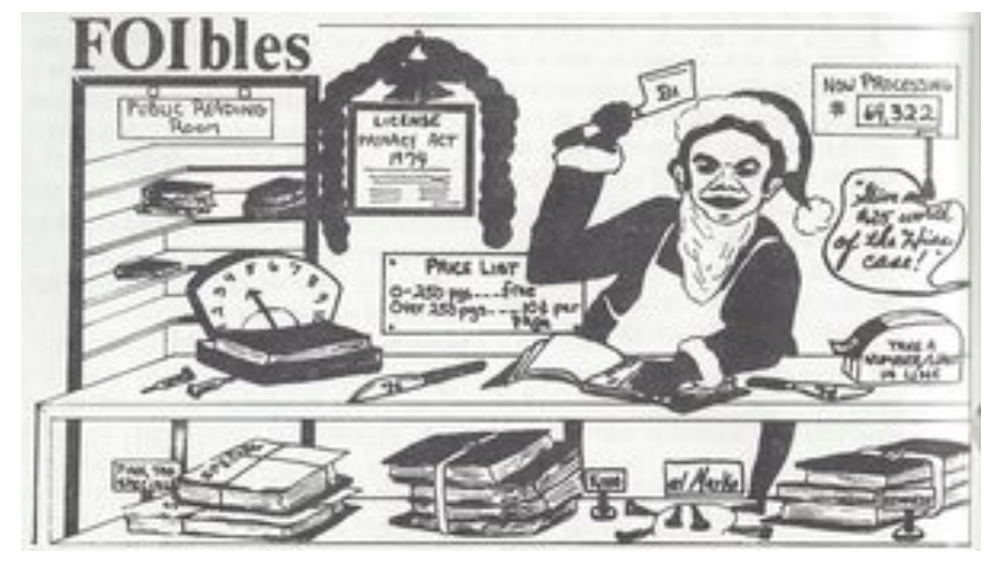
FOIbles: The Justice Dept's Forgotten FOIA Comic

By The Memory Hole 2, Aug. 26, 2016

During a brief moment at the beginning of the 1980s, the Justice Department published a single-panel gag comic about the Freedom of Information Act.  FOIbles was aimed at FOIA staff within the government, so it gives us an unexpected look at the mindset of those who process FOIA requests.

FOIbles ran in the newsletter FOIA Update, put out by the Justice Department's Office of Information Policy from late 1979 to early 1999. The cartoon ran in only eight issues (the first seven, plus the ninth issue).  The OIP has posted the complete text of FOIA Update here, but all images - photos, illustrations, and cartoons - were left out.  I scanned this forgotten footnote of FOIA history from original printed copies of the newsletter.  All FOIbles are reproduced below, in the order in which they appeared.

Read more here.

FOIA News: HHS Denies FOIA Request on Carcinogen Study

FOIA News (2015-2024)Kevin SchmidtComment

HHS Denies FOIA Request on Carcinogen Study

By Jack Fitzpatrick, Morning Consult, August 31, 2016

The Department of Health and Human Services denied a conservative advocacy group’s Freedom of Information Request about communications on glyphosate, a herbicide at the center of a debate over potential carcinogens.

The Free Market Environmental Law Clinic, which is affiliated with the conservative Energy and Environment Legal Institute, requested communications documents from Gloria Jahnke, a scientist with the department’s National Institute of Environmental Health Sciences, pertaining to glyphosate. But officials rejected the request, saying that even emails in the department’s possession belong to the International Agency for Research on Cancer, a wing of the World Health Organization that Jahnke had worked with, which isn’t subject to FOIA requirements.

“IARC is the sole owner of all such materials,” the agency’s response to the FOIA request says. “IARC does not encourage participants to retain working drafts of documents after the related Monograph has been published.”

Read more here.

FOIA News: Most journalists support "release-to-one-release-to-all" policy, according to survey

FOIA News (2015-2024)Allan BlutsteinComment

Report on survey of journalists' views on "release to one, release to all" FOIA policy

By Adam Marshall, Reporters Committee for Freedom of the Press, Aug. 31, 2016

The Reporters Committee for Freedom of the Press is publishing the results of its survey of journalists on the "release to one, release to all" policy under the federal Freedom of Information Act (FOIA). More than 100 self-identified journalists responded to the survey.

Respondents to the survey were generally in favor of a “release to one, release to all” policy if it is implemented with a delay between release to the requester and release to the public. While a quarter of respondents supported the policy unconditionally, almost 60% support it only with conditions, such as a delay period.

Many journalists indicated that they believe there would be detrimental effects if others can immediately access records they receive in response to a FOIA request. In particular, if a third party is allowed to “scoop” the results of those efforts, not only do the incentives for filing FOIA requests decline, but the quality of stories might suffer.

Read more here.

Court opinion issued Aug. 29, 2016

Court Opinions (2015-2024)Allan BlutsteinComment

Brown v. Perez (10th Cir.) -- reversing decision of U.S. District Court for the District of Colorado that granted summary judgment to U.S. Department of Labor, which had withheld the names and business addresses of treating physicians from certain worker compensation records pursuant to Exemptions 4 and 6.  With respect to Exemption 4, the Tenth Circuit held that the agency could not demonstrate the likelihood of substantial competitive harm by relying upon an unsworn letter from a third party that had objected to disclosure.  Regarding Exemption 6, the Circuit questioned the agency's unsupported claim that the treating physicians had any cognizable privacy interests in their business addresses.  Moreover, the Circuit rejected the agency's post hoc argument that disclosure would implicate the physicians' financial information.  Lastly, the Circuit held that the district court improperly permitted agency to withhold printouts of certain computer menu screens, because the agency had put forth no evidence as to whether those records were "readily reproducible."

Summaries of all opinions issued since April 2015 available here.    

FOIA News: Farm Credit Insurance Corp. amends FOIA regs without seeking public comment

FOIA News (2015-2024)Allan BlutsteinComment

The Farm Credit Insurance Corporation issued a final rule today that amends its FOIA regulations to reflect the changes made by the FOIA Improvement Act of 2016.  The Corporation explained that it decided not to seek public comment before issuing the rule because the "proposed amendments are required by statute, do not involve Corporation discretion, and provide additional protections to the public through the existing regulations.  Thus, notice and public procedure are impracticable, unnecessary, and contrary to the public interest."

Q&A: Winter, spring, summer, or fall . . . all you've got to do is call

Q&A (2015-2024)Allan BlutsteinComment

Q.   I have been a U.S. citizen for approximately 50 years, yes 50 years!!! I lost my naturalization papers which I need in order to get another hard copy of my SS card, which I also lost.  I was told by the USCIS office to submit a foia request while waiting for my papers and should not take longer than 30 days. It has now been 60 days and I am still on number 4 of 10 when I check the status.  Last week I was 3 of 10, but when I checked again the end of the week I had gone down to 4.  EXTREMELY FRUSTRATING!!!!!!!!!! There is a state of urgency no one appears to care about. I don't want a copy to frame and hang on my wall, I need it to work!!!! How can I communicate with an actual person in that department??!!!

A.  The contact information for the FOIA Public Liaison of the United Stated Citizenship and Immigrations Services is as follows: 

National Records Center, FOIA/PA Office
P. O. Box 648010
Lee's Summit, MO. 64064-8010
FOIA Officer/Public Liaison: Jill Eggleston
Phone: 1-800-375-5283 (USCIS National Customer Service Unit)
Fax: 816-350-5785
E-mail: uscis.foia@uscis.dhs.gov

I note in this context that FOIA backlog at USCIS was significant enough to trigger a putative class action lawsuit in 2015.  

FOIA News: Independent assessment finds federal agency release rate for FOIA much lower than claimed

FOIA News (2015-2024)Kevin Schmidt1 Comment

Independent assessment finds federal agency release rate for FOIA much lower than claimed

By Tom Susman, Sunlight Foundation, August 26, 2016

On a few occasions in the past couple of months, I have heard the refrain repeated that the Obama administration has a 91 percent disclosure rate for responses under the Freedom of Information Act. Melanie Pustay, the director of the Office of Information Policy at the Justice Department, used that figure at a Columbia conference in New York in June. Shaun Donovan, the director of the White House Office of Management and Budget, recited it at the FOIA Advisory Committee meeting last month.

I was curious about that percentage since it sounded extremely – actually unbelievably – high to me. Professor Peter Strauss also questioned the number during the Columbia conference. I asked a colleague who is adept at data crunching to go on FOIA.gov and see if he could figure out how you reached that number. He was able to identify the relevant FOIA data and incorporated it into the spreadsheet below.

If you include full and partial releases as constituting the total release rate, the ratio for all agencies in FY 2015 is 90.6 percent. That is likely where you are getting the 91 percent figure. That total release rate is not included as part of the FOIA data, but it has been added to the spreadsheet as the last column (highlighted in blue) by adding the released in full and released in part ratios.

If you look at the rates separately, for all agencies in FY 2015, the released in full ratio is 51.84 percent and the released in part ratio is 38.76 percent. We’ve inserted those numbers at the bottom of the spreadsheet where the total numbers for all agencies are calculated.

Read more here.

Court opinions issued Aug. 25 & 26, 2016

Court Opinions (2015-2024)Allan BlutsteinComment

Aug. 26, 2016

Gov't Accountability Project v. Food & Drug Admin. (D.D.C.) -- holding that Section 105 of the Animal Drug and User Fee Amendments of 2008 does not qualify as an Exemption 3 statute, and denying summary judgment to both parties with respect to whether disclosure of records concerning antimicrobial drugs sold and distributed in 2009 would likely cause harms protected by Exemption 4.  

Yunes v. U.S. Dep't of Justice (D.D.C.) -- ruling that the State Department adequately searched the embassy of the Dominican Republic for records concerning plaintiff's visa revocation, and that all of the FBI's withholdings were proper except for its application of Exemption 3 in conjunction with the Bank Secrecy Act to withhold a Financial Crimes Enforcement Network report.

Bartko v. U.S. Dep't of Justice (D.D.C.) -- finding that the Securities and Exchange Commission conducted an adequate search for records pertaining to plaintiff's criminal prosecution.  

Aug. 25, 2016

N.Y. Times Co. v. Nat'l Sec. Agency (S.D.N.Y.) -- determining that the NSA properly redacted information from two Inspector General reports pursuant to Exemption 1 and denying in camera review because the agency's declaration "articulated a reasonably detailed explanation for the redactions which was both logical and plausible."

Summaries of all opinions issued since April 2015 available here.  

Q&A: Can the DEA just say no?

Q&A (2015-2024)Allan BlutsteinComment

Q.  Can the Drug Enforcement Administration (DEA) closed investigations be FOIAed? I submitted a DEA FOIA request seven days ago and I've yet to receive an acknowledgement that my request was received.

A.  Nearly all agency records are subject to FOIA, though not all may be released, of course. The fact that a DEA investigation is deemed "closed" merely affects whether DEA may rely upon Exemption 7(A) to withhold records.  If the investigation concerns a third party, the DEA is likely to withhold certain records under Exemptions 6 and 7(C) -- and based upon my experience reviewing DEA records, Exemptions 7(D), 7(E), and 7(F) -- or it might even refuse to confirm or deny the existence of records depending on the circumstances.   

If your request will take longer than ten days to process, the agency is required provide you with an individualized tracking number -- which is usually transmitted via an acknowledgment letter.  If you have a question about the status of your request, here is DEA's contact information:  Tel. (202) 307-7596 (Hotline); Fax: (202) 307-8556
Email: DEA.FOIA@usdoj.gov.