FOIA Advisor

FOIA News: Judge rejects proposed FBI production timeline

FOIA News (2015-2024)Ryan MulveyComment

Judge balks at FBI's 17-year timeline for FOIA request

Josh Gerstein, Politico, July 29, 2017

Getting answers to Freedom of Information Act requests is often a protracted and tiring process, but how long a wait is too long?

One federal judge just came up with an answer: 17 years.

U.S. District Judge Gladys Kessler bluntly rejected the Federal Bureau of Investigation’s proposal that documentary filmmaker Nina Seavey wait until the year 2034 to get all the law enforcement agency’s records for a request pertaining surveillance of anti-war and civil rights activists in the 1960s and 1970s.

The request involved an unusually large amount of material — about 110,000 pages of records at the FBI and more at other agencies — but Seavey said waiting almost two decades for the complete files wasn’t viable for her.

“Literally, they were talking 17 years out. I’m 60 years old. You can’t do that math,” the George Washington University professor and documentarian told POLITICO this week. “It wasn’t going to work for me.”

Read more here.
Court opinion issued July 28, 2017

Court Opinions (2015-2024)Allan BlutsteinComment

Mattachine Soc'y of Wash. v. DOJ (D.D.C.) -- finding that: (1) FBI failed to adequately search for records concerning Executive Order 10450; (2) FBI properly withheld certain information pursuant to Exemptions 3 and 7(D); and (3) FBI properly withheld certain names pursuant to Exemption 7(C), but that public interest warranted that names be replaced with uniquely identifiable alphanumeric markers and production of index.

Summaries of all opinions issued since April 2015 available here.  

Court opinions issued July 24-July 27, 2017

Court Opinions (2015-2024)Allan BlutsteinComment

July 27, 2017

White v. Office of the Fed. Defender for the Middle Dist. of Fla. (S.D. Ill.) -- spontaneously dismissing lawsuit as frivolous because defendant is not a federal agency subject to FOIA.

July 26, 2017

Am. Marine v. IRS (S.D. Cal.) -- ruling that: (1) IRS failed to demonstrate that it performed reasonable search for responsive records; (2) IRS properly withheld records pursuant to Exemptions 3 (26 U.S.C. § 6103(e)(7)), 5, 7(A), and 7(D); (3) IRS failed to address whether "Risk Score" withheld under Exemption 7(E) was technique unknown to public; and (4)  judgment would be reserved as to Exemption 3 (26 U.S.C. § 6103(a)) and Exemption 6 until record was further developed.

July 25, 2017

Jackson v. GSA (E.D. Pa.) -- concluding that both GSA and Treasury performed reasonable searches for records concerning plaintiff's unsuccessful application for employment as IRS agent.

James Madison Project v. DOJ (D.D.C.) -- finding that Department of Defense performed an adequate search for certain records concerning soldier's memoir about killing Osama Bin Laden, and that agency properly withheld information pursuant to Exemption 5 (which plaintiff conceded).  

July 24, 2017

Stein v. SEC (D.D.C.) -- deciding that: (1) agency was obliged to search for certain requested records even though plaintiff once had access to them during discovery phase of litigation; (2) agency properly withheld records pursuant to Exemptions 3 (Bank Secrecy Act), 7(A), and 7(C); and (3) plaintiff failed to provide sufficient information to determine whether certain records withheld under Exemption 7(A) were also properly withheld under Exemption 5 

Gahagan v. U.S. Citizenship & Immigration Servs. (E.D. La.) -- determining that FBI properly relied on Exemption 7(E) to withhold certain information from two pages referred to it by USCIS.

Summaries of all opinions issued since April 2015 available here.  

FOIA News: Recap of Chief FOIA Officers Council meeting

FOIA News (2015-2024)Allan BlutsteinComment

Can agencies build greater trust in the FOIA process?

By Chase Gunter, FCW, July 28, 2017

With limited resources and an increasing workload, agency officials hope that technology can help automate practices to make the government more transparent.  First, however, they need to improve the practices themselves.

The process surrounding Freedom of Information Act requests has engendered frustration over both the lengthy time it takes to receive responses and the not-so-transparent aspects of the process surrounding the 50-year-old transparency law.

 At a July 27 Chief FOIA Officers Council meeting, the issues of limited resources and manpower, combined with the recent boom in the number of requests, were repeatedly recognized as challenges by both FOIA officials and requesters.

Read more here.

FOIA News: FOIA Project Reports on Rise of FOIA Lawsuits by Nonprofit Groups

FOIA News (2015-2024)Kevin SchmidtComment

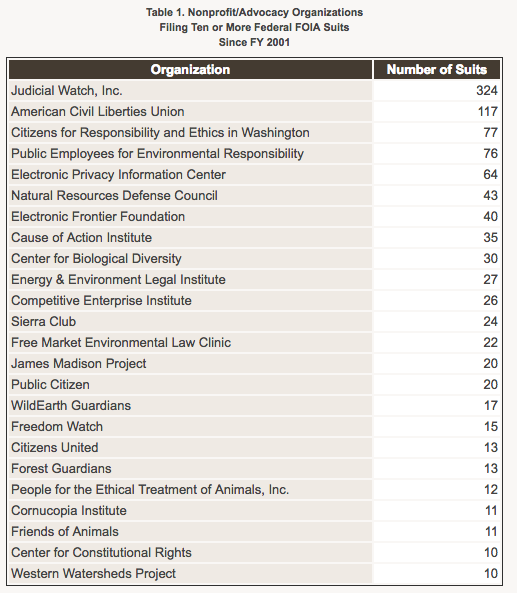
Dramatic Rise in FOIA Lawsuits Filed by Nonprofit Advocacy Groups

The FOIA Project, July 26, 2017

The number of FOIA lawsuits filed by nonprofit and advocacy organizations has generally grown over the past two decades, irrespective of which political party was in office — from the George W. Bush administration, through President Obama’s eight years, and continuing during Donald Trump’s first months as president. These findings emerge from a detailed study of court records by the Transactional Records Access Clearinghouse (TRAC), a data research center at Syracuse University.

Read more here.

FOIA News: Recap of Commerce's rescheduled Sunshine Week event

FOIA News (2015-2024)Allan BlutsteinComment

Spring Open: Events Celebrate Transparency in Government

By Barbie E. Keiser, Information Today, Jul 25, 2017

Several months into the new administration, Washington, D.C., was treated to events to learn about efforts to increase openness and transparency in government. Some speakers focused on the current situation, highlighting resource challenges that are facing all three branches of government, while others looked to the future and the technology that would enable government to keep up with the expectations of citizens. Here are the highlights of each event.

Commerce Department Belatedly Celebrates Sunshine Week

Originally scheduled for March 15, 2017, during Sunshine Week, but postponed due to a snowstorm in D.C., Strengthening Transparency through Open Data and Access to Information was finally held on June 20 at the Commerce Research Library. It was then that individuals from seven Commerce Department bureaus received certificates of recognition for reducing the Freedom of Information Act (FOIA) backlog by 10% or exceeding their bureau’s FOIA goals—for example, by closing their 10 oldest FOIA requests.

Read more here.

FOIA News: FOIA Advisory Committee tackling tech

FOIA News (2015-2024)Allan BlutsteinComment

The future of FOIA

By Chase Gunter, FCW, July 24, 2017

Technology has helped the government become more efficient and transparent in many areas. That hasn’t been the case, however, for a law written to increase transparency. Now a group of agency and private-sector officials are working with agencies to develop recommendations to improve the situation.

The Freedom of Information Act Advisory Committee, created in 2014, seeks to streamline the process for requesting documents under FOIA and bridge the gap between requesters and government agencies -- many of which have unique requirements for FOIA requests.

Read more here.  

Court opinions issued July 20, 2017

Court Opinions (2015-2024)Allan BlutsteinComment

Seavey v. DOJ (D.D.C.) -- ordering FBI to process 102,000 pages of responsive records concerning Vietnam War at a rate of at least 2,850 pages per month, which exceeds agency's policy of processing 500 pages per month for voluminous requests. 

Huntington v. U.S. Dep't of Commerce (D.D.C.) -- determining that U.S. Patent and Trademark Office failed to perform an adequate search within one office for records concerning a confidential program, but that it properly withheld a disputed document pursuant to deliberative process privilege.

Smart-Tek Automated Servs. v. IRS (S.D. Cal.) -- ruling that: (1) IRS failed to demonstrate that it performed reasonable search for responsive records; (2) IRS properly withheld records pursuant to Exemptions 3 (in conjunction with 26 U.S.C. 6103(e)(7)), 5, 6, 7(A), and 7(D); (3) IRS failed to address whether records withheld under Exemption 7(E) revealed techniques unknown to public; and (4) judgment would be reserved as to Exemption 3 (in conjunction with 26 U.S.C. 6103(a)) and Exemption 7(C) until record was further developed.

Summaries of all opinions issued since April 2015 available here.  

FOIA News: Lawsuit seeks to uncover DOJ's involvement in "congressional records" flap

FOIA News (2015-2024)Allan BlutsteinComment

The War on the Freedom of Information Act

A conservative group is resisting congressional efforts to kneecap FOIA.

By Michelle Cottle, The Atlantic, July 23, 2017

The health-care clusterfudge continues. Senator John McCain has brain cancer. President Trump throws another public tantrum. Russia, Russia, Russia.

That about covers the Big Political Headlines of the week. Now for something really sexy: the creeping assault on the Freedom of Information Act.

Stop right there! No clicking over to that Tucker Carlson YouTube rant. This is another one of those ticky-tacky, below-the-radar issues that may sound like a nonprescription substitute for Ambien but is, practically speaking, super important—especially in the Age of Trump.

Read more here.