FOIA Advisor

FOIA News: More on NARA's 2024 records management report

FOIA News (2015-2025)Allan BlutsteinComment

Agencies Increasingly Applying AI in Processing FOIA Requests, Says Report

FEDweek, Oct. 6, 2025

Almost a fifth of federal entities that process FOIA requests are using AI and machine learning, and those “early adopters are demonstrating the ability of AI to identify sensitive information and normalizing the concept of AI in FOIA processing,” says a report.

That is a “notable” number as agencies are looking to apply AI improve efficiency in searching for and retrieving records that may be responsive to FOIA requests, said the report based on responses from some 280 federal entities to a survey earlier this year on their FOIA compliance activities.

Read more here.

Court opinion issued Oct. 1, 2025

Court Opinions (2025)Allan BlutsteinComment

Jackson v. HHS (D. Nev.) -- dismissing plaintiff’s claim against the Centers for Medicare and Medicaid Services for lack of standing because plaintiff did not personally submit requests for records about CMS’s investigation of him for Medicaid fraud; instead, the requests were submitted by his private investigator, who never informed CMS that he was acting on plaintiff’s behalf.

Summaries of all published opinions issued in 2025 are available here. Earlier opinions are available for 2024 and from 2015 to 2023.

FOIA News: FOIA buzz at the SEC

FOIA News (2015-2025)Allan Blutstein1 Comment

A Grassroots FOIA Campaign Swarms the SEC

FOIAengine: How Obscure MMTLP Became a Cause Célèbre 

By John A. Jenkins, Law St. Media, Oct. 1, 2025

At the Securities and Exchange Commission, the inbox has been filling up with hundreds of near-identical Freedom of Information Act requests about a little-known company called Meta Materials, Inc., whose stock once traded under the ticker symbol MMTLP.  

Most of those FOIA requests aren’t signed by big law firms or Wall Street players, but rather by aggrieved retail investors and citizen activists who buy into a conspiracy theory:  that actions taken by the SEC and its self-regulatory arm, FINRA, in the interest of protecting investors actually constituted regulatory missteps that wiped out their investments.  

There have been lawsuits, bankruptcies, death threats, and calls for Congress or the Trump Administration to take action.  In one anonymous message to a market veteran reported by the Wall Street Journal, the sender alluded to mass shootings and vowed to come “piss on your casket.”

Big financial players – notably Citadel, and the online market maker Virtu – have been targeted and are fighting subpoenas.  FINRA, the Financial Industry Regulatory Authority that writes and enforces rules for registered brokers and broker-dealer firms in the U.S., also has been pulled into litigation.   The hashtag #FinraFraud went viral.     

Read more here.

Monthly Roundup: September 2025

Monthly Roundup (2024-2025)Allan BlutsteinComment

Below is a summary of the notable FOIA court decisions and news from last month, as well as a look ahead to FOIA events in October.

Court opinions

We posted and summarized 29 opinions in September. Highlights include N.Y. Times v. DOJ (S.D.N.Y., Sept. 4, 2025), in which the court held DOJ did not “improperly” withhold Volume II of Special Counsel Jack Smith’s report concerning President Trump’s alleged mishandling of classified documents, because an injunction issued by a federal court in Florida prohibits the report’s release. The court rejected plaintiff’s collateral attack on the Florida court’s jurisdiction since its order had at least a colorable basis in protecting co-defendants’ fair trial rights and it was implicitly recognized by the Eleventh Circuit. Notably, on September 30, 2025, the advocacy group American Oversight petitioned the Eleventh Circuit to lift the injunction at issue.

Speaking of American Oversight, it scored a win against HHS in its lawsuit—on remand from the D.C. Circuit—seeking communications between the agency and congressional Republicans concerning healthcare reform legislation. See Am. Oversight, Inc. v. HHS (D.D.C. Sept. 24, 2025). Of note, the court concluded that the disputed communications were agency records, not congressional records, after finding that a generic “Legend” on the records was insufficient to show Congress had clearly manifested intent to control them.

Top news

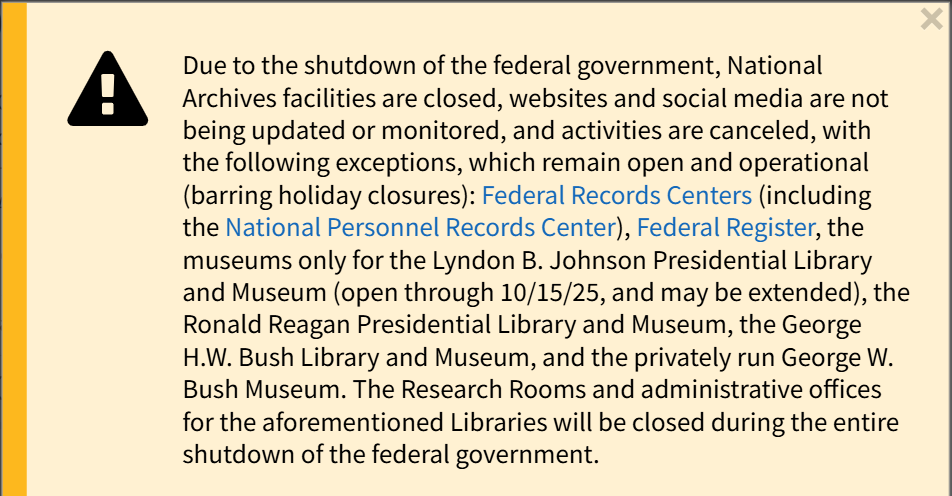
  • On the last day of fiscal year 2025, OIP posted agency reporting deadlines for FY 2026, issued guidance on fiscal year 2026 Chief FOIA Officer reports, and posted a summary and assessment of FY2025 CFO reports. At the stroke of midnight, the government began a partial shutdown from lapses in appropriations.

  • USAID issued a global “still interested” notice on September 16, 2025, requiring requesters to confirm their interest in all FOIA requests submitted to the agency before January 20, 2025.

  • The FOIA Advisory Committee met on Sep. 11th.

  • The Department of Energy was sued on September 3, 2025, over its August 14th still-interested notice.

October calendar

Oct. 7: DOJ/OIP Virtual Annual FOIA Report Refresher and Quarterly Report Training

Oct. 14-16: Graduate USA Freedom of Information and Privacy Act Courses

Oct. 15: DOJ/OIP Virtual Chief FOIA Officer Report Refresher Training

Oct. 16: D.C. Circuit oral argument, Accuracy in Media v. DOD, No. 24-5165.

Oct. 29-31: Management Concepts The Privacy Act and The Freedom of Information Act Training

Oct. 31: FY25 Q4 Data Due

FOIA News: OGIS publishes compliance assessment of VA FOIA office

FOIA News (2015-2025)Ryan MulveyComment

On September 26th, the Office of Government Information Services (“OGIS”) published its Compliance Assessment Report for the U.S. Department of Veterans Affairs FOIA Office. The full report can be found here, although OGIS has also published a summary with its top-line findings and recommendations here.

OGIS’s fifteen findings were as follows:

1. VA acknowledged requests in an average of two weeks after receipt in fiscal year (FY) 2024, but veterans seeking their own records from the Veterans Benefits Administration (VBA) waited an average of five months to receive records. (Recommendation 1)

2. VA’s handling of first-party requests, particularly with regard to the intersection between FOIA and the Privacy Act, is complex and confusing. (Recommendation 2)

3. VA’s confusing communication to veterans seeking their own benefits records prevents them from knowing whether they can expect administrative rights under FOIA. (Recommendations 3-5)

4. VA is not consistently complying with the FOIA statutory requirement to provide requesters with estimated dates of completion (EDCs) upon request. (Recommendation 6)

5. Letters from VA’s FOIA program to requesters are not written in plain language. (Recommendation 7)

6. VA’s reporting on the administration of FOIA appears to be inconsistent, complicating review of the FOIA program’s performance. (Recommendations 8-10)

7. VA’s decentralized system for obtaining records relies on collateral duty staff to locate records and process requests for records which slows the process. (Recommendation 11)

8. The technology and systems that VA uses to maintain records and process FOIA requests are siloed and not always efficient. Multiple programs are used to process FOIA requests and the platforms are unable to communicate with each other. (Recommendation 12)

9. Communication about VA’s FOIA program on the agency’s website is not always clear and consistent, and there is no FOIA handbook as required by the FOIA statute. (Recommendations 13 and 14)

10. VA’s FOIA program contact information and FOIA Public Liaison information on FOIA.gov, the government’s central website for FOIA, is often not correct. (Recommendation 15)

Court opinions issued Sept. 30, 2025

Court Opinions (2025)Ryan MulveyComment

Farahi v. Fed. Bureau of Investigation (D.C. Cir.) — affirming the district court; holding that the requester’s FBI file was protected against disclosure under Exemption 7(A); noting, at the outset, that the district court properly recognized the FBI had “carried its burden” to demonstrate the records at issue were compiled for law enforcement purposes; noting further that the lower court “correctly concluded that disclosure could be reasonably expected to interfere with pending or reasonably anticipated enforcement proceedings” given the requester’s past history and longstanding ties to the “Egyptian Muslim Brotherhood,” “Khaled Sheikh Mohammed and other known Al Qaeda members,” and “multiple convicted or indicted terrorists,” including “Jose Padilla”; rejecting the requester’s objection to the FBI’s categorical use of the exemption; determining the agency had taken reasonable steps to segregate and release nonexempt information from the FBI file, even though those efforts were largely described in an ex parte declaration.

Am. Transparency v. Dep’t of Health & Human Servs. (D.D.C) — in a case involving records about the payment of royalties—or so-called “inventor awards”—to employees of the National Institutes of Health, denying the parties’ cross-motions for summary judgment; concluding the agency could not withhold the requested information pursuant to Exemption 6 because “[f]ederal government employees have a limited privacy interest in information about their compensation,” and “there is a clear public interest” vis-a-vis “question[ing] whether investors’ financial interests in the success of their technologies affects how they conduct clinical trials”; rejecting the agency’s asserted foreseeable harms under Exemption 6, such as violation of the “expectation of trust and confidentiality that licensees and inventors have with NIH,” and “limit[ing] bargaining opportunities” of employees once they leave government service; determining there is a “genuine dispute of material fact” as to whether Exemption 3, in conjunction with the Federal Transfer and Technology Act, and Exemption 4 might apply because it is unclear “whether it is possible to back-calculate how much a licensee pays in royalties from the amount NIH distributes to an individual inventor.”

McKathan v. Dep’t of Homeland Sec. (D.D.C.) — granting the government’s motion for summary judgment; holding that the pro se requester failed to exhaust administrative remedies with the Executive Office for U.S. Attorneys by filing an appeal; rejecting the argument that the component’s non-adverse determination was improper because it lacked a notice about appeal rights; holding further that the Criminal Division conducted a reasonable search.

Doe v. Immigration & Customs Enf’t (D.D.C.) — in a case involving records about ICE’s improper disclosure of an asylum applicant’s confidential information, denying the parties’ cross-motions for summary judgment and providing the agency “another opportunity” to defend its withholdings; holding that the agency had not sufficiently justified its use of Exemption 5; noting the agency did not explain how records withheld under the deliberative-process privilege actually played part of any “decisional process”; noting further that, while ICE had shown why the attorney-client privilege would apply in part to records reflecting requests for legal advice, it had not demonstrated the application of the privilege to documents reflecting the provision of legal advice; holding further that the agency failed to identify non-generic foreseeable harms from disclosure, and did not tie such harms to the records at issue; of particular note, concluding that ICE’s asserted foreseeable harms for records withheld under the attorney-client privilege were too “broad [and] categorial,” as the agency incorrectly assumed a “per se harm[]” stemming from “disclosing any attorney-client material” could satisfy the statutory standard.

Heritage Found. v. Dep't of Justice (D. Del.) — granting the government’s motion for summary judgment; holding that a declarant from the Executive Office for U.S. Attorneys was competent of laying a factual foundation for defending the agency’s withholdings, despite not having first-hand knowledge of the underlying records, which originated in the Special Counsel’s Office; holding further that the agency properly applied Exemption 5 (together with the deliberative-process, attorney-client, and attorney work-product privileges) to various categories of records, including draft congressional correspondence and related internal communications, handwritten notes, and e-mail; concluding that DOJ properly withheld the names of U.S. Attorney’s Office employees and references to an employee family member under Exemption 6; finally, holding the agency properly withheld an internal file name used to reference the Hunter Biden investigation under Exemption 7(E).

Summaries of all published opinions issued in 2025 are available here. Earlier opinions are available for 2024 and from 2015 to 2023.

FOIA News: An oldie but a goodie on gov't shutdowns

FOIA News (2015-2025)Allan BlutsteinComment

Calculating FOIA Response Times after the Government Shutdown

DOJ/OIP, FOIA Post, Oct. 29, 2013

As federal employees returned to work after the recent government shutdown, OIP has been asked by many FOIA professionals how these recent events will impact their agency’s FOIA reporting.  Specifically, agencies have asked whether the recent government shutdown affected how agencies should count the number of days used to respond to FOIA requests and administrative appeals. When considering how to calculate the number of days used to respond to FOIA requests and administrative appeals for agency Annual FOIA Reports, the following guidance should apply:

Agencies and requesters alike generally refer to the FOIA’s time limits as “working days.”  Logically, then, they could easily conclude that during a time when FOIA Offices had no choice but to be closed because of the lapse in funding, those days when employees were furloughed were not “working” days and so should not be counted as part of the FOIA’s response times.  As a matter of policy, however, and consistent with the spirit of openness in administering the FOIA, agencies should count as part of their response times for FOIA requests and appeals the eleven days when the government was closed, which excludes the Saturdays, Sundays, and the one legal public holiday that occurred during the shutdown.

Our hope and expectation is that requesters will fully understand that even though agencies will be including these shutdown days in their calculations of response times, that because FOIA personnel were not able to work during that period, there will necessarily be an impact on processing times. OIP’s FOIA Counselor Service and Annual FOIA Report Team are available to answer any questions on this guidance or any other topic regarding FOIA administration, and can be reached at (202) 514-FOIA (3642).

See original post here.